
The short version
Microcontroller prices are moving up again — but anyone expecting a replay of the 2021 everything-shortage will misread this market. What the evidence shows as of October 2, 2026 is a structural squeeze, not a broad shortage: AI-related products are occupying 8-inch mature-node capacity, selectively crowding out 32-bit automotive and industrial MCUs, while 8-bit and consumer-grade parts stay largely calm. The confirmed facts: STMicroelectronics raised prices for the third time this year effective August 23; ADI started its second 2026 round on September 13; Renesas has officially notified customers of another increase from January 1, 2027 (magnitude undisclosed); China's Nationz raised selected high-performance MCUs 10%–20% from October 1. The reported-but-unconfirmed side: DigiTimes cites supply-chain sources saying ST MCU lead times exceed a year. And the complicating reality from distributors: spot prices haven't fully followed the official letters — "far from a broad shortage," as multiple distributors told Huxiu. This guide separates what's confirmed from what's reported, and gives buyers four moves for Q4. This article is for informational purposes only and does not constitute investment or procurement advice.
Why this isn't 2021 again
The 2021 shortage hit everything at once — MCUs, power devices, passives, all lead times blown out together. The 2026 picture is different in three ways. First, the pressure is selective: 32-bit MCUs for automotive and industrial applications are tight; 8-bit and consumer MCUs are described across sources as basically stable. Second, the driver is capacity allocation, not demand explosion: foreign analysts note this round is "not driven by strong end demand — consumer and industrial end demand is roughly flat — but by tight supply and rising mature-node costs" (Taiwan Times, October 1). Third, the price signals are layered, not uniform: official price letters are real, but spot-market pass-through is uneven — distributors report domestic MCU prices "still competing on price" even as official letters go out (Huxiu, late September). Buyers who plan for 2021-style blanket stockpiling will overpay; buyers who assume "it's all hype" will miss the real pinch in 32-bit industrial parts.
The AI squeeze: how mature-node capacity got crowded
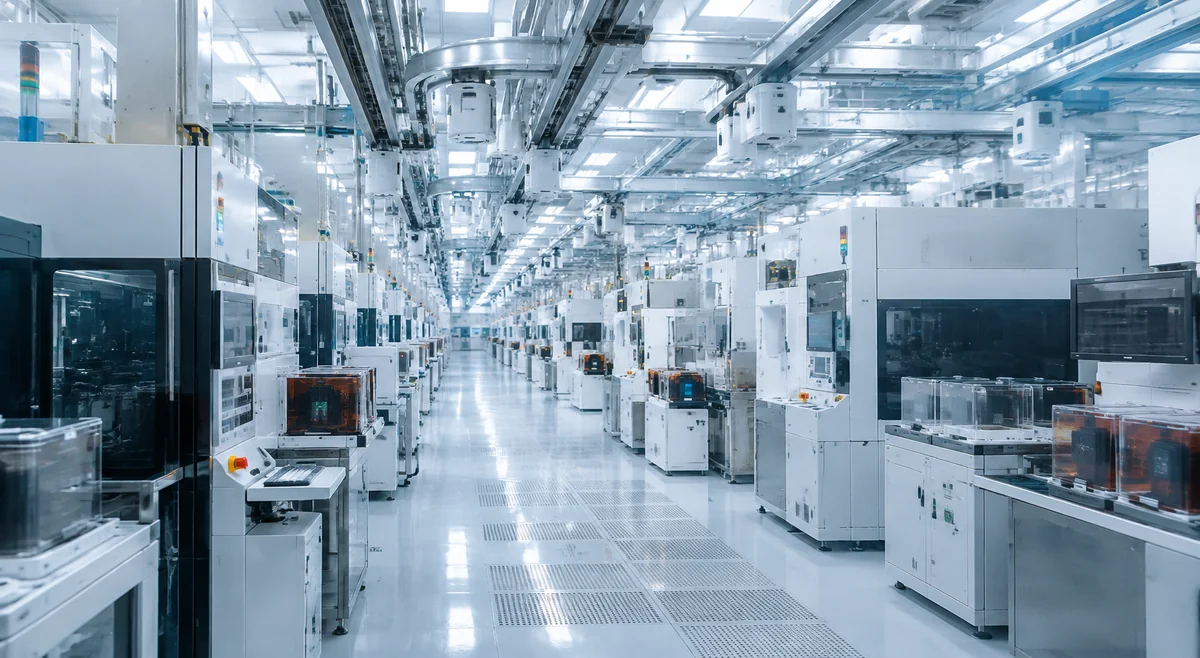
The mechanism behind the structural squeeze is straightforward. High-performance computing chips each ship with large numbers of supporting MCUs, PMICs, sensors, and MOSFETs — "mature-node companion demand" (21st Century Business Herald, September 21). As AI demand absorbs advanced capacity, the profitable AI-adjacent products also bid for 8-inch mature-node wafers, and foundries reallocate accordingly. TrendForce data: top-ten foundries' 8-inch utilization was 88% in 2026 (about 80% in 2025), rising toward 90% in the second half. Samsung is closing its 8-inch S7 fab in Hwaseong in H2 2026, removing capacity at the margin. UMC, VIS, and Vanguard all report high utilization; UMC has signaled price increases, and domestic foundry JHM raised prices 10% from June 1. The result: 32-bit MCUs — which live on these mature nodes — get selectively squeezed out, while their official list prices rise to reflect higher wafer costs. This is cost push plus allocation squeeze, not a demand boom. Notably, no manufacturer's official statement in this round cites tariffs as a driver — the stated reasons are consistently wafer, material, energy, packaging, and logistics costs.
The 2026 price-hike timeline: third round for the internationals
International vendors are now on their second or third increase of the year — a cadence worth tracking because each round resets the baseline for negotiations:
- STMicroelectronics: third 2026 increase effective August 23 (official; magnitude undisclosed). Separately, power-device lead times reportedly hit 52 weeks (TrendForce, August 21).
- ADI: second 2026 round from September 13 across the full portfolio; nearly 1,000 "/883" military part numbers up as much as 30% (official).
- Renesas: officially notified customers of another increase from January 1, 2027, citing structural cost increases in materials, energy, advanced packaging, manufacturing capacity, and logistics. The magnitude was not disclosed — any article quoting a Renesas percentage is inventing it.
- Microchip: notified customers of increases on selected MCUs and analog ICs from mid-August (reported via company notice).
- TI: five price adjustments in the past twelve months — across the full portfolio, not MCU-specific; don't let anyone narrow this to MCUs.
- Infineon: two rounds this year, the second in July targeting AI-server power and automotive power devices at 10%–20%.
- Holtek (Taiwan): confirmed in August a full-MCU-line increase of up to 20% (official).
- Nationz (China): selected high-performance MCUs (industrial, AI power, digital power) up 10%–20% from October 1 (official).
- The pattern: international vendors move first and repeatedly; domestic vendors follow with disclosed ranges. For buyers, the practical takeaway is that the "current" price on any quote is a moving target — always demand a price-validity date in writing.
The other side: the spot market hasn't fully followed
Here's the part the panic headlines skip. Distributors interviewed by Huxiu in late September were blunt: this round of domestic MCU increases "reflects cost and supply push, not a spot market entering a high-profit phase"; domestic MCU prices "are still competing"; STM32 pricing has been volatile — surging in March on stretched lead times, then cooling; heating again late June on price letters and channel controls, then cooling again by late July. Their conclusion: "far from a stage of broad shortage and broad price increases." Third-party market data shows STM32F103RCT6 moving from about ¥7 to ¥8–9 and STM32F407VET6 around ¥12 — real moves, but orderly, not explosive (eet-china). Channel statistics for August: some top-brand MCU lead times broke 52 and even 60 weeks with prices rising in parallel; ST at 40–52 weeks, Infineon at 10–97 weeks (distributor/channel data, not official). The honest picture for a buyer: official letters are real and costs are really rising, but spot availability exists and panic buying at any price is the wrong response. The opportunity hidden in the squeeze: DigiTimes cites supply-chain views that ST's stretched lead times benefit Taiwanese MCU vendors — the substitution window is open.
Procurement playbook — four moves for Q4
Four moves, in priority order:
- Segment your BOM by process node, not by vendor. The squeeze lives on 8-inch mature nodes. Identify which of your MCUs are 32-bit automotive/industrial parts on mature processes — those are the at-risk population. 8-bit and consumer parts can stay on normal ordering cadence.
- Get price-validity dates in writing, now. With vendors on their second or third increase of the year and Renesas's January 2027 round already notified, any quote without a validity window is fiction. For Q4 coverage, lock quotes before the next round lands.
- Qualify second sources while the window is open. Taiwanese and domestic MCU vendors are actively pricing to win substitution business during the international squeeze. Qualification takes months — starting now means having options when (not if) a lead-time notice hits your primary source.
- Don't panic-buy the spot market. Distributor data shows spot prices moving orderly, not explosively. Paying panic premiums today burns budget you'll need when the real allocation notices arrive. Buy to your segmented plan, not to the headlines.
Frequently asked questions
Quick answers to the questions buyers ask most about the MCU market right now.
- Q: Is there really an MCU shortage? A: There's a structural squeeze on 32-bit automotive/industrial MCUs tied to 8-inch capacity allocation. There is no broad shortage — 8-bit and consumer parts are stable, and distributors say the market is "far from" broad-shortage conditions.
- Q: Which vendors have officially raised prices? A: ST (third 2026 round, Aug 23), ADI (second round, Sep 13), Renesas (notified, effective Jan 1 2027, magnitude undisclosed), Holtek (up to 20%), Nationz (+10%–20% from Oct 1), Microchip (selected parts, mid-Aug). TI's five adjustments are portfolio-wide, not MCU-specific.
- Q: Are ST lead times really over a year? A: That figure comes from DigiTimes citing supply-chain sources — it is reported, not officially confirmed. ST has not published lead-time statements. Treat it as a credible signal, not a fact.
- Q: Should I worry about tariffs driving MCU prices? A: None of the manufacturers' official statements in this round cite tariffs; the stated drivers are wafer, material, energy, packaging, and logistics costs. Don't model tariff impact on MCU pricing without separate sourcing.
Sources
Use the latest guidance for the exact part and manufacturer when deciding acceptance criteria.
- DigiTimes (2026-09-14) — ST MCU lead times reportedly over a year; supply-chain sources
- TrendForce (2026-09-11) — Renesas to raise prices again from Jan 2027 (official notice)
- TrendForce (2026-08-21) — ST plans third 2026 price hike for August 23
- Altium Resources (2026-09) — 8-inch utilization 88%→90%; onsemi lead times 27→32 weeks
- 21st Century Business Herald (2026-09-21) — foundry utilization; mature-node companion demand
- Taiwan Times (2026-10-01) — not demand-driven; Microchip notice; Holtek confirmation
- Huxiu (late 2026-09) — distributor interviews; spot-market divergence
- eet-china — STM32 spot pricing (third-party market data)
- Jiemian News (2026-10-01) — Nationz +10%–20% from Oct 1
- Tencent News (2026-08-14) — ADI September 13 round