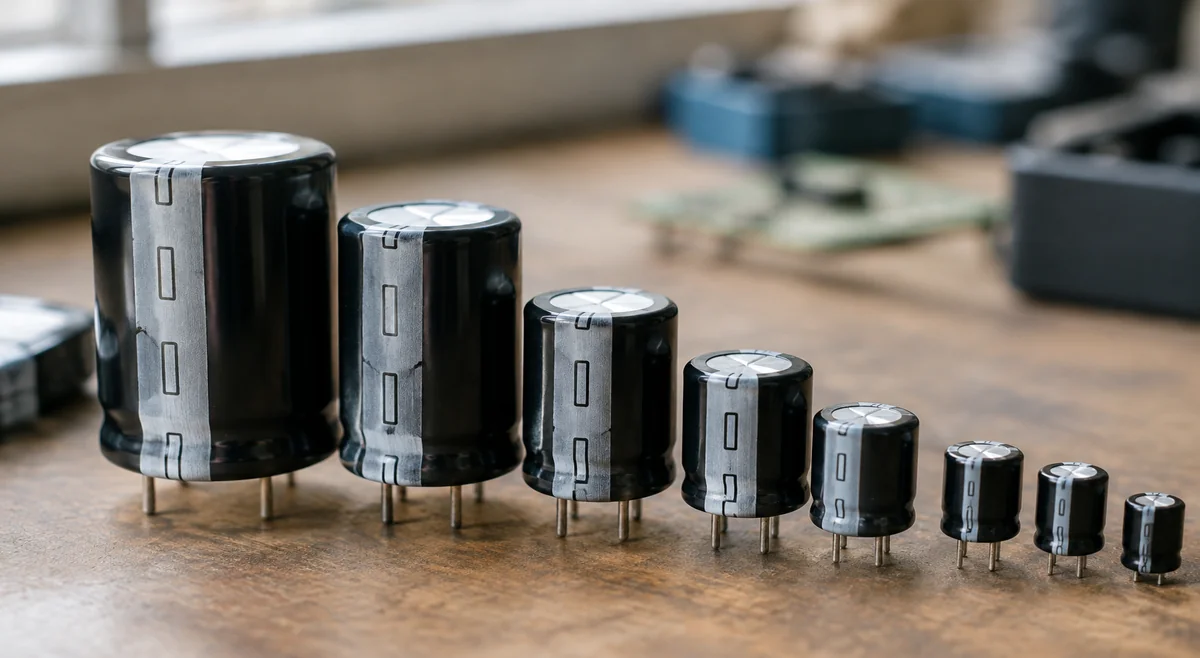
Wet, polymer or hybrid: pick the electrolyte first
Aluminum electrolytics split into three families, and the family choice drives everything downstream. Conventional wet types use a liquid electrolyte: they offer the highest capacitance per dollar, self-heal small dielectric defects, but lose electrolyte slowly through the seal — heat is what accelerates that loss. Solid polymer types replace the liquid with a conductive polymer, giving very low ESR and high ripple-current tolerance with no dry-out mechanism, at a higher price and with higher DC leakage. Hybrids keep a small amount of liquid alongside the polymer, holding most of the polymer’s low ESR while keeping leakage closer to wet levels. The decision is a three-way trade, not a ranking. Wet aluminum wins where the ripple is low-frequency and bulk capacitance dominates — mains rectifiers, hold-up banks, general filtering — because nothing beats its cost per microfarad. Solid polymer wins on switching-converter outputs where high ripple current would cook a wet part from the inside. Hybrids are the compromise pick when the board must survive cold-to-hot swings and the circuit cannot tolerate polymer-level leakage, such as standby rails in battery-backed equipment. A third-party deep dive maps the same comparison and is worth a read for the temperature-stability curves. The classic mistake is treating a polymer part as a drop-in “upgrade” for a wet part of the same capacitance and voltage. Leakage is the first thing to recheck — polymer leakage runs several times higher than wet — and so is the voltage ceiling, since polymer ranges top out well below what wet aluminum reaches. If the control loop was tuned with the wet part’s ESR in the picture, removing that ESR can change loop behavior too. Upgrade deliberately, not by footprint alone.
- Wet aluminum: cheapest bulk capacitance, self-healing, but lifetime is set by electrolyte loss — keep it cool.
- Solid polymer: very low ESR and high ripple tolerance, no dry-out, but higher leakage and higher cost.
- Hybrid: most of the polymer’s low ESR with wet-like leakage — the middle ground for wide-temperature boards.
- Never swap families on capacitance and voltage alone; recheck leakage, ESR and the voltage ceiling.
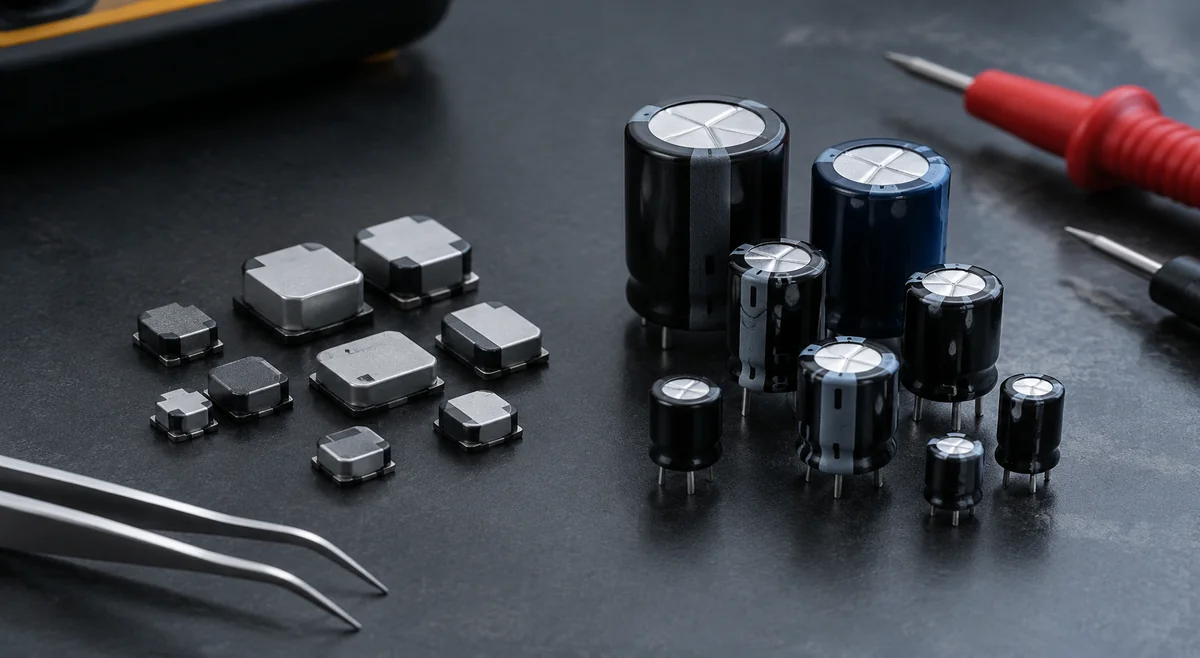
Read the ripple rating at your frequency, not the datasheet headline
Ripple current is the parameter buyers under-read most. A datasheet’s headline ripple rating is specified at one frequency — often 100 kHz for SMD parts — while your circuit’s ripple may be 100 or 120 Hz after rectification or hundreds of kilohertz at a switcher output. Makers publish frequency correction factors for exactly this reason, and applying the wrong one is the classic undersizing error: a part that looks adequate at the headline number can be overstressed at the real frequency. Ripple matters because it becomes heat. Ripple current through ESR dissipates power inside the part, raising core temperature above ambient — and as the next section shows, core temperature is what sets lifetime. The risk to design for: a bulk capacitor that passes bench tests, then runs hot inside the finished enclosure where the ambient is far higher than the lab assumed. The fix is margin: run each part well below its corrected ripple rating, and split heavy ripple across parallel parts so each one stays cool. Take EEE-FK1V101P as an illustration of what a wet-aluminum spec actually states: Panasonic lists it as a 100 µF, 35 V SMD aluminum electrolytic with its 600 mArms ripple rating specified at 100 kHz and a 2000-hour endurance rating (official page). If your ripple lives at a different frequency, that headline number is the starting point, not the answer — the correction factor decides. For the converter side of the same design, our buck converter selection guide covers how input and output ripple shape the surrounding circuit.
- Always apply the datasheet’s frequency correction factor to the headline ripple rating.
- Ripple × ESR becomes internal heat — derate ripple current, not just voltage.
- Parallel parts share ripple; two cool capacitors outlast one hot one.
- Confirm the ripple spec temperature basis matches your worst-case enclosure, not the lab bench.
Treat lifetime as a temperature budget
Endurance hours — the “2000 h” figure on a datasheet — are measured at the maximum rated temperature. Real service life is set by the actual core temperature: ambient plus the self-heating from ripple current. The industry rule of thumb is that every ~10 °C the core runs cooler roughly doubles the life, which is why the same part can last a decade in a cool enclosure and a couple of years next to a heatsink. That gives buyers two levers, and they combine. The first is buying a longer-life series for hot positions rather than the cheapest standard series. The second is thermal derating: a larger case, lower ripple stress per part, and placement away from hot components all buy lifetime without changing the bill of materials much. Note how a part ends its life, too — datasheets define end of life by capacitance loss and ESR rise together, and in practice ESR drifts out of the ripple budget before capacitance visibly drops. The common misread is quoting “2000 hours” as three months of service. Translate the rating into your temperature budget instead: at a realistic operating point well below the maximum, the service life stretches far beyond the headline figure. When a product’s warranty depends on it, ask the maker for the lifetime-versus-temperature curve for the exact series — it is the one document that turns a catalog number into a service-life commitment.
- Endurance hours are rated at maximum temperature; your cooler operating point extends them substantially.
- ~10 °C cooler core temperature roughly doubles service life — heat is the budget.
- Two levers: longer-life series, and thermal derating (bigger case, shared ripple, cooler placement).
- End of life is capacitance loss plus ESR rise — ESR usually exits the budget first.
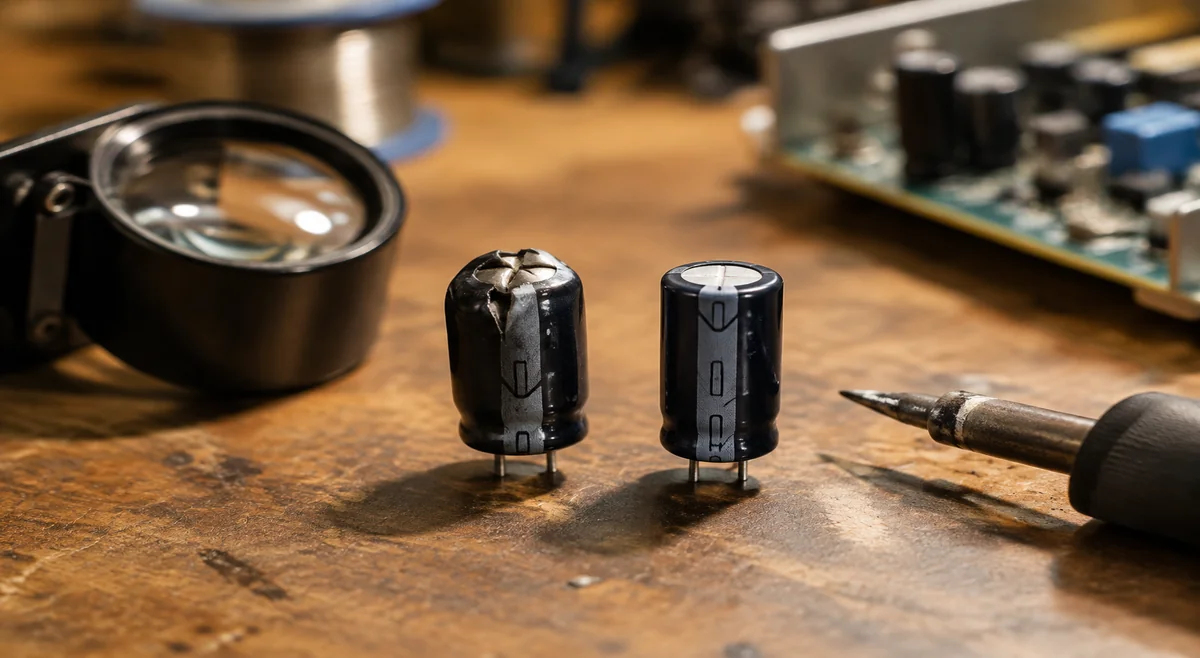
ESR and leakage: the two quiet trade-offs
ESR in wet aluminum is strongly temperature-dependent, and the cold corner is where it bites. EE Times notes that wet-aluminum ESR can rise by an order of magnitude at −40 °C — which inflates output ripple voltage and can push a switching loop tuned at room temperature toward instability. If the product must start and regulate in the cold, specify ESR at the cold temperature, not just at 25 °C. The same source flags the voltage-rating paradox buyers should internalize: a higher voltage rating means a thicker dielectric, which means higher ESR — so under heavy ripple, the “safer” higher-voltage part can actually run hotter and die sooner than a correctly rated one. Running at roughly 80% of rated voltage is the practical derating norm; buying far more voltage than the rail needs is not free insurance. Leakage is the other quiet cost, and it belongs to the polymer side. Solid polymer types leak several times more DC current than wet types — a non-issue on a mains-powered rail, a real load in battery-powered or micropower standby circuits where every microamp counts. That is where hybrids or plain wet parts earn their place. And above the electrolytic’s useful frequency range, pair it with ceramics for high-frequency decoupling — see our MLCC selection guide for how effective capacitance under bias decides that pairing.
- Check wet-aluminum ESR at your coldest operating temperature, not just 25 °C.
- Higher voltage rating can mean higher ESR — in ripple-limited designs, oversizing voltage shortens life.
- Derate to roughly 80% of rated voltage as standard practice.
- Polymer leakage is several times wet-level: fine on mains rails, a real budget item on battery standby.
Buy like the capacitor sets the warranty
Procurement discipline decides as much as engineering here. Always order the complete ordering code including the series — one maker’s 100 µF 35 V can span standard, long-life and low-impedance series with very different ripple and endurance figures, and a “same spec” substitute from another series is not the same part. Teams often discover that the cheapest line on the BOM is the component that sets the product’s warranty, so the series choice deserves the same scrutiny as an IC. Date codes matter more for electrolytics than for most passives. Wet types age in storage, and reels that have sat past the maker’s shelf-life guidance may need reforming before assembly — a step skipped in a hurry becomes a field failure a year later. Set a date-code acceptance policy, confirm it on the quotation (see our date-code guide), and qualify a second source in the same footprint before you need one. On the RFQ itself, ask for what the datasheet headline hides: ripple rating at your operating frequency, the endurance series and its temperature basis, ESR at your coldest temperature, and the leakage class for any battery-backed rail. A supplier who answers those four precisely is one you can build a long-life product on — our RFQ guide shows how to phrase them so the answers come back usable.
- Order the full ordering code with series — same µF and voltage across series are different parts.
- Enforce a date-code policy; long-stored wet stock may need reforming before assembly.
- Qualify a second source in the same footprint before supply gets tight.
- RFQ the four hidden items: ripple at your frequency, endurance basis, cold ESR, leakage class.
Frequently asked questions
Quick answers to the electrolytic-capacitor questions buyers ask most.
- Q: Can I replace a wet aluminum capacitor with a polymer one of the same capacitance and voltage? A: Usually the capacitance fits, but recheck three things: polymer leakage runs several times higher, polymer voltage ranges top out lower, and a loop tuned with the wet part’s ESR may behave differently with ESR removed. Hybrids sit between the two.
- Q: Is a higher voltage rating always safer? A: No. A higher voltage rating can mean thicker dielectric and higher ESR, so under heavy ripple the oversized part can run hotter and fail sooner. Derating to roughly 80% of rated voltage is the practical norm.
- Q: How do I estimate real service life from a “2000 h” rating? A: That figure is measured at maximum rated temperature. Estimate your real core temperature — ambient plus ripple self-heating — and apply the rule of thumb that ~10 °C cooler roughly doubles life.
- Q: Do I need to worry about shelf life on new reels? A: Yes for wet types: electrolyte and seals age in storage, and stock held past the maker’s shelf-life guidance may need reforming before use. Set a date-code acceptance policy and avoid old stock for long-life products.
Sources
Use the latest guidance for the exact part and manufacturer when deciding acceptance criteria.