Start with the loss you are actually paying for
Every diode decision is really a decision about which loss you are willing to pay. Three losses compete: conduction loss from forward voltage drop times current, switching loss from reverse-recovery charge at your operating frequency, and reverse leakage power — reverse voltage times leakage current at your actual junction temperature, not the 25 °C headline. So start with three answers: the worst-case repetitive reverse voltage including spikes, the switching frequency, and the hottest junction temperature the part will see in service. Low voltage and high current with little switching points at the lowest forward drop; high frequency points at the least stored charge; a hot enclosure points away from leaky families. Name the dominant loss first and the family almost picks itself.
- List worst-case reverse voltage, switching frequency and maximum junction temperature before opening any parametric table.
- Conduction loss rewards the lowest forward drop; switching loss rewards the least stored charge; hot service punishes reverse leakage.
- When two losses matter, rank them — the top one chooses the family, the runner-up chooses the part.
Three families, three jobs
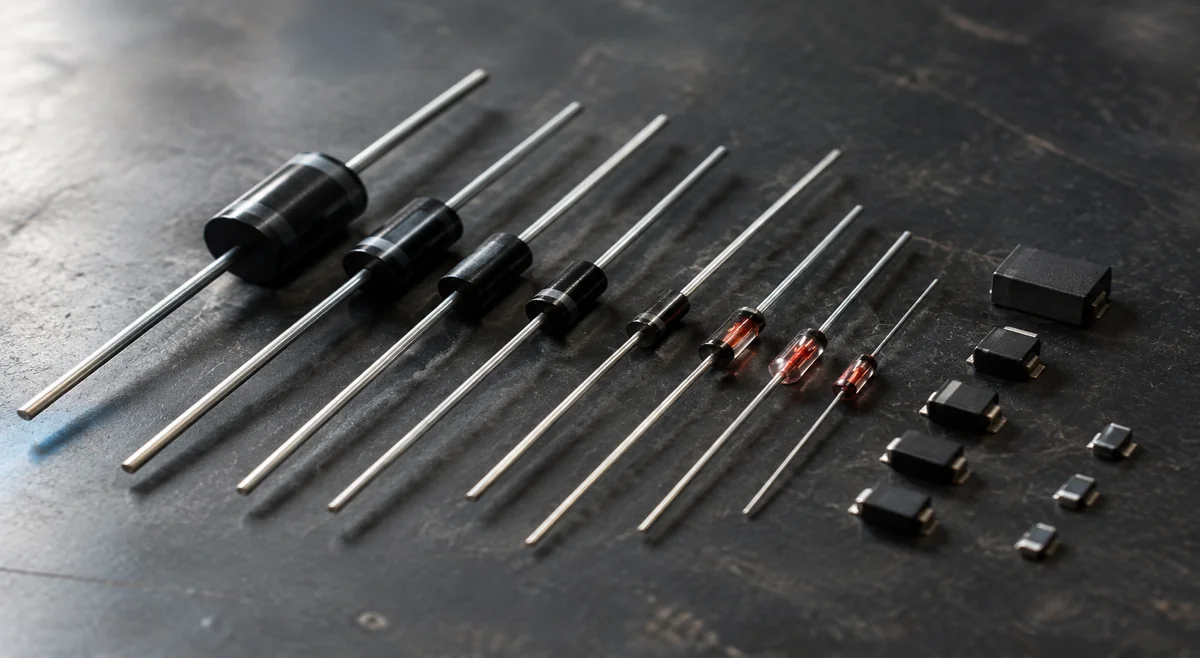
Schottky diodes use a metal-semiconductor junction, a majority-carrier device with essentially no stored charge, so turn-off is clean and fast and the forward drop is the lowest of the three families. The trade is a limited reverse-voltage range and higher reverse leakage than PN-junction types. That makes them the natural fit for low-voltage, high-frequency work: freewheeling in DC-DC converters, ORing, and reverse-polarity protection where every millivolt of drop costs battery life. The Sourceics catalog includes Schottky options such as 1N5819 and the surface-mount SS14 for exactly this class of job. Fast and ultra-fast recovery diodes are PN-junction devices built for higher reverse voltages with lower leakage, but they pay with a higher forward drop and real recovery charge that must be managed. Soft-recovery variants round off the turn-off waveform to cut ringing and EMI at a small efficiency cost — a deliberate trade, not a defect. Pick this family when the reverse voltage exceeds what Schottky covers, or when leakage at temperature rules Schottky out: higher-voltage switching supplies and motor drives are the classic territory. Standard rectifiers are the slow, cheap workhorses. At mains frequency their sluggish recovery costs nothing, and their high voltage ratings are inexpensive — fine for line-frequency bridges and low-frequency flyback clamps. The expensive mistake is dropping one into a switching converter because a diode is a diode; there, recovery charge becomes a heating element and the part fails for a reason the datasheet headline current never warned about. For the small-signal end of the spectrum, 1N4148W switches fast but is not a power rectifier — keep the jobs separate.
- Schottky: lowest drop and cleanest turn-off, but respect the voltage ceiling and the leakage.
- Fast recovery: the pick once reverse voltage or hot-environment leakage pushes past what Schottky covers.
- Standard rectifier: correct at line frequency, a liability at switching frequency.
- Soft-recovery variants trade a little efficiency for quieter switching — choose them deliberately for EMI-sensitive boards.
The leakage trap: check reverse current at hot, not at 25 °C
A common thermal trap: a board that passes every room-temperature test and then fails inside a warm enclosure — reverse leakage has quietly become the largest power term, feeding on its own heat. Schottky reverse leakage climbs steeply with junction temperature, and leakage power is voltage times current: at high reverse voltage, microamps at room temperature become milliamps at temperature, and the dissipated power raises the temperature further. Maker guidance says the same in plain terms. Toshiba's usage notes for Schottky barrier diodes warn that their reverse leakage is greater than other diode types, making them more susceptible to thermal runaway under high-temperature, high-voltage conditions, and that both forward and reverse power losses belong in the thermal design. ST's application note on Schottky devices in ORing applications frames part selection around the thermal-runaway law: evaluate reverse losses at the worst-case junction temperature and keep them clear of the runaway boundary. The practical method is simple: read the reverse-current-versus-temperature curve at your maximum junction temperature and full reverse voltage, multiply to get leakage power, and put it in the thermal budget beside conduction loss. If leakage power is approaching conduction loss, you have the wrong family or the wrong part — derate harder, add cooling, or move to fast recovery.
- Read reverse current at your maximum junction temperature — the 25 °C figure is decoration for hot designs.
- Leakage power (reverse voltage times hot leakage) belongs in the thermal budget next to conduction loss.
- In hot, high-voltage service, derate Schottky aggressively or switch to fast recovery where leakage dominates.
- Treat a part that only survives at 25 °C as a part that does not survive your application.
Derate the reverse voltage like a buyer, not a datasheet reader
Vrrm is a survival limit, not an operating point. Layout inductance, switching spikes and line surges all stack instantaneous voltage on top of the rail, so the repetitive peaks the diode actually sees are higher than the schematic suggests. Keep those peaks well below the rated reverse voltage with real margin, and size the margin to how spiky the circuit is rather than to a fixed rule of thumb. This is also where buying discipline pays. Write the derating margin into the specification on the BOM line instead of naming a single family — that keeps alternates from other makers qualified and your second sourcing alive. And when the voltage genuinely does not fit Schottky, change families early: a fast-recovery diode run comfortably beats a Schottky run at the edge of its rating.
- Size the reverse-voltage margin against spikes and surges, not the nominal rail.
- Specify the derating rule on the BOM line so alternates from other makers stay qualified.
- Switch families early when the voltage does not fit, instead of stretching a part past its comfort zone.
Packages are thermal ratings in disguise
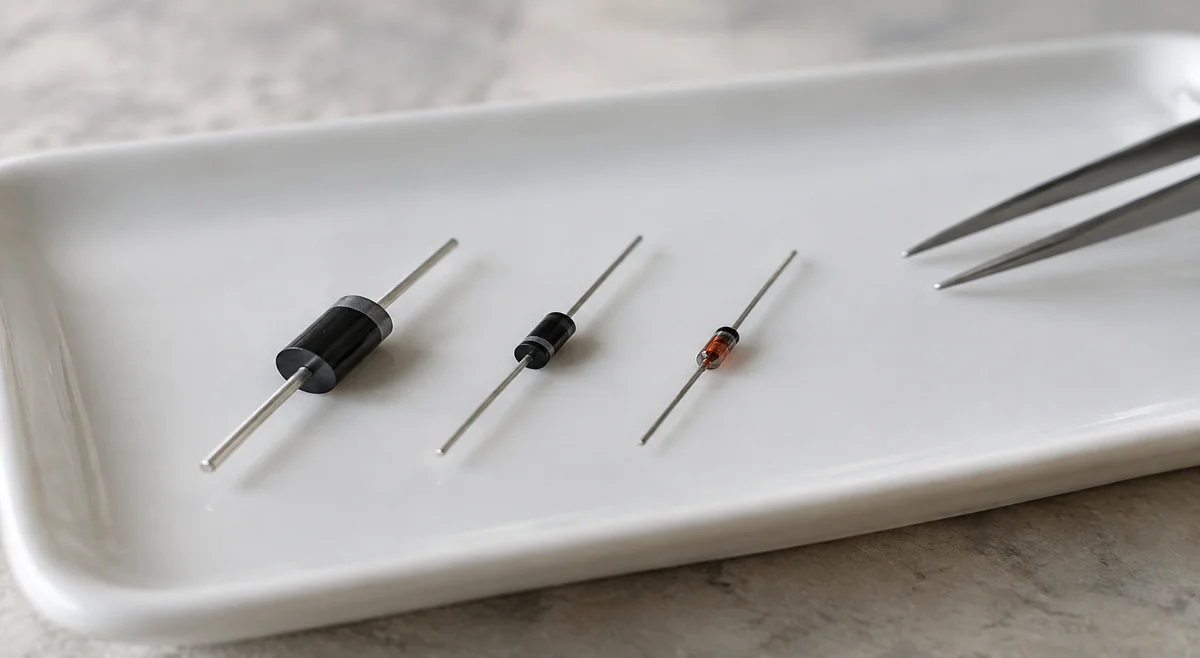
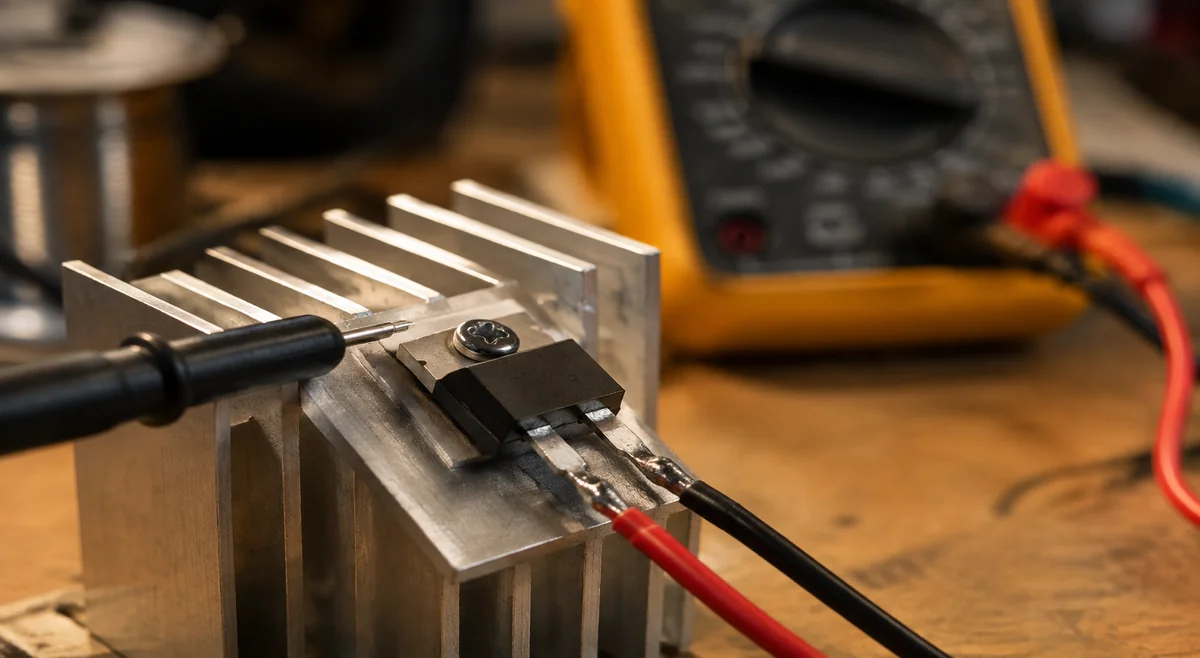
A diode's current rating is measured with specified copper area and cooling; on a minimal board with thin traces, the same part behaves like a smaller one. Total heat is forward power plus reverse-leakage power, and the package can only shed what the board lets it shed — copper pour, thermal vias and airflow are part of the rating whether the headline admits it or not. Teams often discover that the datasheet current rating assumes copper and airflow their board simply does not have — and the fix is usually more copper, not a bigger diode. Match the package to the thermal job: a small surface-mount Schottky such as SS14 is right for compact low-power switching, while the same electrical ratings in a larger package with a heatsink path serve continuous higher-current duty. For DC-DC output stages, pair this guide with the buck converter selection guide; for pairing rectifiers with protection, see the TVS and ESD selection guide. List the finalists on one RFQ with the reverse-voltage margin and maximum junction temperature stated — that keeps competing quotes comparable instead of merely cheap.
- Translate every current rating into a thermal question: where does the heat go?
- Add copper or airflow before upsizing the diode — it is usually the cheaper fix.
- Keep small-signal parts like 1N4148W on signal duty; they are not power rectifiers.
- Confirm the full ordering code and the thermal conditions behind the headline ratings before committing the BOM.
Frequently asked questions
Straight answers to the questions buyers ask most before a diode lands on the BOM.
- Q: Can I swap a fast-recovery diode for a Schottky to cut conduction losses? A: Only if your worst-case repetitive reverse voltage stays comfortably inside the Schottky rating and you have checked reverse leakage at your maximum junction temperature. Otherwise the swap trades efficiency for reliability.
- Q: Why does my diode run hot when the average current is within rating? A: Average current hides the real heating terms — recovery charge at your switching frequency and reverse leakage at your operating temperature. Check both curves in the datasheet, not just the headline current.
- Q: Do I really need to derate the reverse voltage? A: Yes. Switching spikes and line surges stack on top of the rail, so repetitive peaks run higher than the schematic suggests. Keep them well below Vrrm and write the margin into the specification so alternates stay qualified.
- Q: Which family is right for a mains-frequency power supply? A: Standard rectifiers. At line frequency their slow recovery costs nothing and high voltage ratings are cheap. Reserve Schottky and fast recovery for switching circuits, where speed actually pays.
Sources
Use the latest guidance for the exact part and manufacturer when deciding acceptance criteria.
- Nexperia — Schottky, SiGe or recovery rectifiers: choosing the most suitable power diode (PDF)
- ST — Thermal runaway law in Schottky diodes used in ORing applications (application note)
- PCBSync — Diode types: Schottky, Zener, TVS and LED selection
- Toshiba — Basics of Diodes: reverse current, temperature dependence and thermal runaway (application note, PDF)