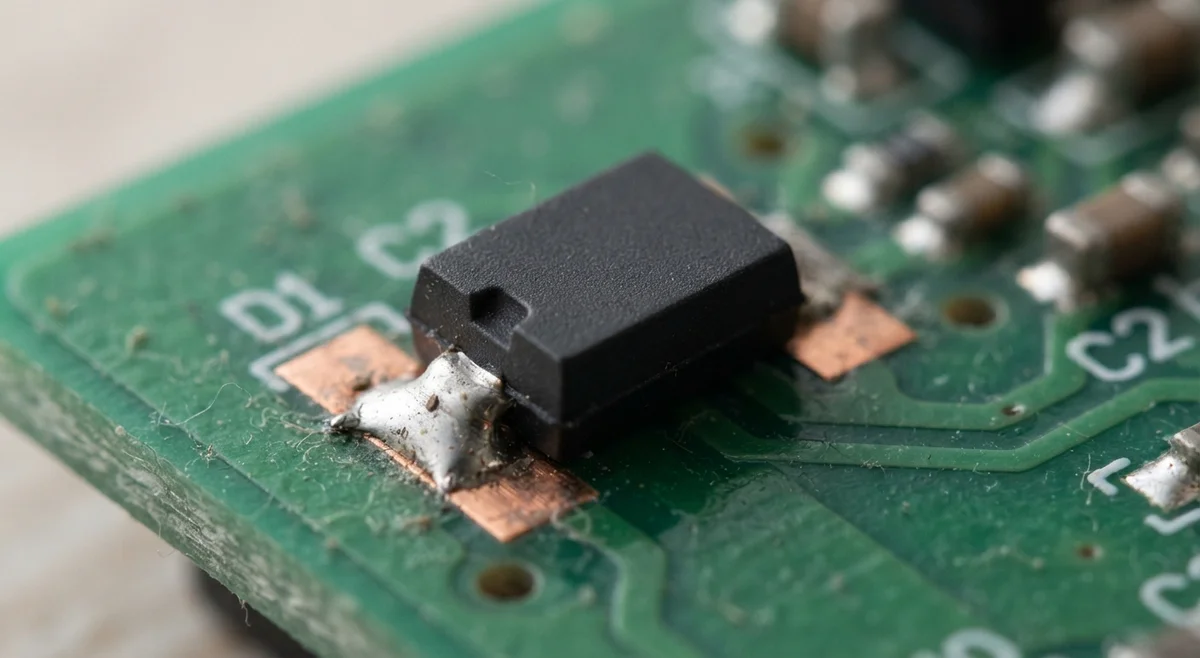
The five numbers that decide a TVS
Every TVS choice comes down to five parameters, and GigaDevice AN051 lays out the selection order: reverse standoff voltage VRWM must sit above the highest normal working voltage (a 1.1 to 1.2 times margin over VCC is the guide’s rule of thumb), breakdown voltage VBR is where protection starts to act, clamping voltage VC must stay below the maximum transient the downstream circuit can survive, peak pulse current IPP and power PPPM must cover the expected surge with margin, and junction capacitance Cj plus leakage IR must not disturb the signal. Get VRWM wrong and the TVS conducts during normal operation; get VC wrong and the protected chip dies while the TVS survives.
- VRWM above the worst-case working voltage, including tolerances and ripple.
- VC below the absolute-maximum rating of the most fragile downstream pin.
- PPPM sized to the surge test the product must pass, not to the average event.
- Cj and IR checked against signal speed and ADC accuracy, not just protection level.
Unidirectional or bidirectional?
Use a unidirectional TVS on DC power rails and a bidirectional TVS where the line can swing both ways or the polarity is uncertain. GigaDevice AN051 states the rule directly: unidirectional devices suit DC supply circuits, bidirectional devices suit circuits with alternating voltage. A common and expensive mistake is fitting a unidirectional TVS across an AC-coupled or RS-485 line — the first negative half-cycle forward-biases it into a short. The typical result of this mistake: a unidirectional TVS loaded across an RS-485 pair, the bus fails its first power-up, and the "short" turns out to be a correctly soldered but wrongly chosen part. When in doubt about polarity, the bidirectional part is the safe default.
- DC rails, reset lines and unipolar supplies: unidirectional.
- RS-485, CAN, audio and any line that swings negative: bidirectional.
- Confirm the polarity marking on the reel before assembly — mixed stock is a real failure source.
ESD arrays are not surge TVSes
A 600 W SMB-package TVS and a tiny ESD array solve different problems. GigaDevice AN051 notes that TVS diodes carry large junction capacitance in large SMA/SMB packages and serve anti-surge and power-line ESD duty, while silicon ESD arrays are built for signal lines where capacitance must stay small. A USB 2.0 eye diagram can collapse when a generic TVS with tens of picofarads sits on the data pair; swapping in a low-capacitance array typically restores the mask with no layout change. Place protection as close to the connector as possible — every millimeter of trace between the entry point and the clamp is an antenna for the transient.
- High-speed interfaces (USB, HDMI, Ethernet): budget junction capacitance first, clamping second.
- Power ports and long cable runs: budget surge power first, capacitance barely matters.
- Keep the TVS ground return short and wide; a long ground stub defeats a good clamp.
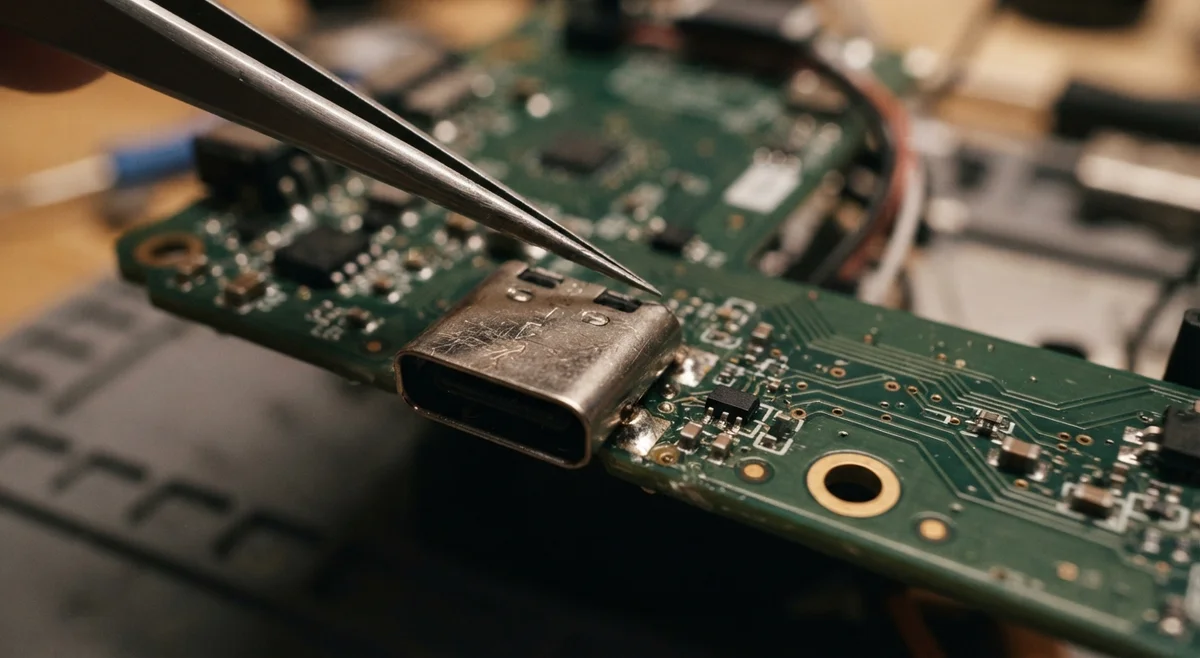
Match the package to the surge: the 400 / 600 / 1500 W ladder
TVS power ratings come in a package ladder, and picking the wrong rung wastes money and board space in opposite directions. Littelfuse’s TVS Diode Catalog & Design Guide lays out the surface-mount series by peak pulse power on the 10/1000 µs waveform: SMAJ at 400 W in DO-214AC (SMA), SMBJ at 600 W in DO-214AA (SMB), SMCJ at 1500 W in DO-214AB (SMC), then SMDJ at 3000 W and 5.0SMDJ at 5000 W for heavy duty. A bigger package means more silicon absorbing the surge — but also more board area and more junction capacitance, which is exactly what high-speed signal lines cannot afford. The buyer rule is to size the package to the threat: a short ESD zap on a connector pin does not need 1500 W, while a lightning-induced surge arriving on a long outdoor cable will overwhelm 400 W. Most 12/24 V industrial DC rails land on the 600 W SMB rung — enough for serious surges, small enough to place anywhere.
- ESD-only duty on signal lines: small packages and arrays win; surge power is not the constraint.
- DC power rails and long cable runs: 600 W SMB is the workhorse; step to 1500 W SMC when the surge spec demands it.
- Compare peak pulse power on the same waveform (10/1000 µs) — ratings quoted on different waveforms are not comparable.

Selection snapshot: four stocked parts
The Sourceics catalog covers a compact protection ladder. SMBJ12A is a Littelfuse 600 W unidirectional TVS in DO-214AA (SMB): 12 V standoff, 13.3 to 14.7 V breakdown at 1 mA, 19.9 V clamping at 30.2 A peak pulse current, and 5 uA max leakage at standoff — a textbook fit for 12 V DC rails. P6SMB6.8CA is a 600 W bidirectional TVS in the same SMB (DO-214AA) package for lines that swing both ways. For signal-line ESD, PESD5V0S1BA is a Nexperia bidirectional single-line device in SOD-323 with 14 V clamping, 5 nA leakage, IPPM of 12 A on the 8/20 us surge waveform and ESD robustness beyond 30 kV to IEC 61000-4-2 level 4. SRV05-4 is a Semtech 4-line low-capacitance TVS array in SOT-23-6 aimed at USB and Ethernet port protection where junction capacitance is the binding constraint.
- SMBJ12A: verify the rail stays below 12 V worst case, and the downstream IC tolerates 19.9 V transients.
- P6SMB6.8CA: choose when the protected line can go negative or polarity is unknown.
- PESD5V0S1BA: single-line 5 V ESD duty with negligible 5 nA leakage for ADC-adjacent pins.
- SRV05-4: four protected lines in one SOT-23-6 for USB/Ethernet connectors.
Procurement checklist for protection buyers
Protection parts are cheap until the wrong one ships in volume. Market signal (observed 2026-10-01): hardware creator 小K聊硬件’s Douyin episode 第5集 | TVS/ESD选型避坑:ESD过认证必看的量产实战指南 (2,701 likes) walks through TVS vs Zener vs ESD-diode differences, voltage and peak-power matching, junction-capacitance choice for high-speed interfaces, uni/bidirectional selection and layout — the same five-number discipline this guide describes, which is why it resonates with production engineers. Confirm the full ordering code: polarity, package and packing suffixes all change what arrives. Ask for the IEC 61000-4-2 and 61000-4-5 test levels on the quotation for ESD parts, and confirm the clamping voltage is quoted at the rated peak current, not at a token test current. When a broker offers an alternate brand, re-run the five numbers — "equivalent" TVSes frequently differ in clamping voltage where it hurts most. Put the shortlist on one RFQ with VRWM, clamping voltage at the rated peak current, and the IEC test levels written into the line items — that forces every quote to answer the five numbers instead of competing on price alone.
- RFQ the exact ordering code; unidirectional and bidirectional variants are one letter apart.
- Require the surge test levels (IEC 61000-4-2 / 4-5) stated on the offer for ESD devices.
- Compare clamping voltage at the same peak current when cross-checking brands.
- Sample one reel and verify polarity and marking before releasing volume.
Frequently asked questions
Quick answers to the TVS and ESD questions buyers ask most.
- Q: Can a TVS replace a fuse? A: No. The TVS clamps transients; the fuse clears sustained faults. Size the TVS so it survives the events the fuse is meant to outlast.
- Q: What TVS do I need on an AC line? A: A bidirectional TVS rated for the AC working voltage, plus coordination with upstream overcurrent protection.
- Q: Why does my ESD diode distort the USB signal? A: Excess junction capacitance on a fast pair. Move to a low-capacitance array rated for the interface speed.
- Q: Does every I/O pin need ESD protection? A: Protect what leaves the enclosure and what a user can touch; internal board-to-board links rarely need it.
Manufacturer references
Use the latest guidance for the exact part and manufacturer when deciding acceptance criteria.