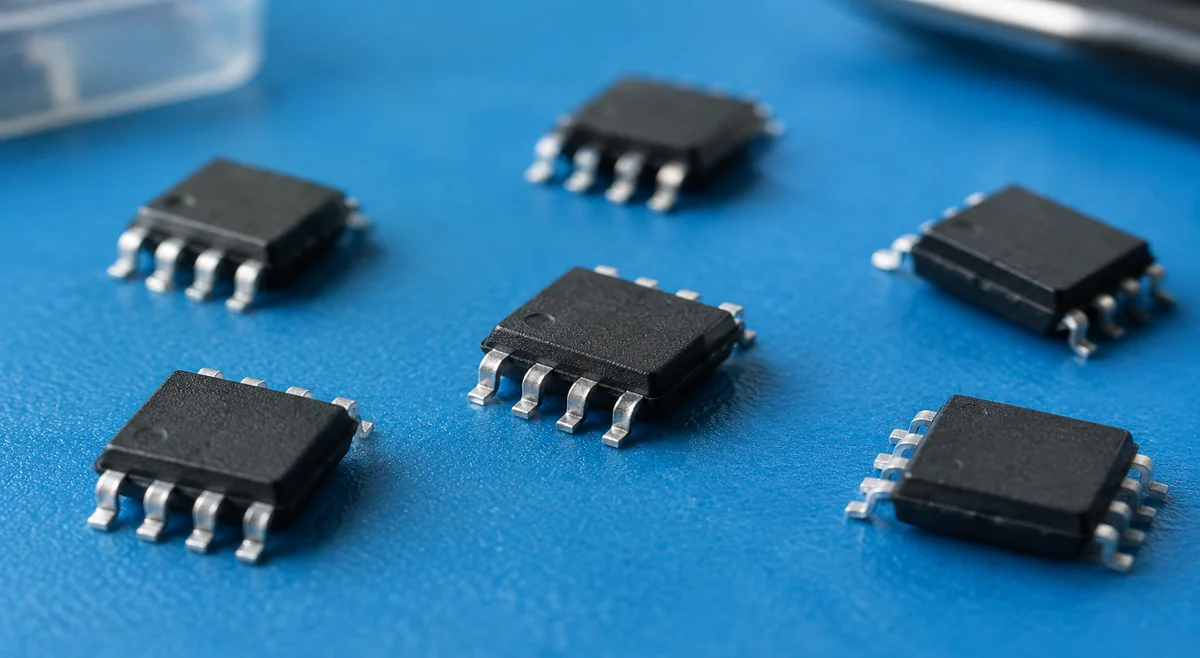
Start from the signal, not the spec table
Most op-amp guides hand you a parameter list — GBW, offset, noise — and leave you to guess which one actually decides. Flip the order: describe your signal first, then let the signal pick the parameter. A slow DC measurement chain lives or dies on offset voltage and its drift with temperature; a few microvolts of wander inside a warm enclosure can consume the whole error budget before bandwidth ever matters. An audio path cares about noise density in the audible band and distortion behavior, not megahertz you will never use. A fast pulse or video signal cares about gain-bandwidth and slew rate — the part must keep up with edges, not just sine waves. Once the signal names its dominant requirement, the datasheet stops being a wall of numbers and becomes a shortlist filter. Everything else is a tiebreaker. Pick the parameter the signal demands, then compare parts on that axis first.
Single-supply changes everything
Many classic op amps were designed for split supplies, and moving them onto a single 5 V or 3.3 V rail changes the rules. First, the signal needs a new home: with no negative rail, ground is no longer mid-scale, so you bias the input at a reference — often half the supply — and AC-couple or level-shift around it. Second, “single-supply” on a datasheet does not automatically mean rail-to-rail; it only means the part is characterized for single-rail operation. Rail-to-rail input and rail-to-rail output are separate claims — verify each one. A JFET-input part like TL082CMX/NOPB is the classic trap: superb for high-impedance sources on split supplies, but its input common-mode range does not reach the rails, so on a single 5 V supply part of your signal window silently disappears. Decide the supply scheme before you shortlist parts, not after the board is laid out. A JFET-input part gets designed onto a single 5 V rail because 'single-supply' appeared on the datasheet — part of the signal window vanished silently, and the fix was a board spin. The supply decision belongs at selection time.
The three precision killers
For DC and low-frequency work, three error sources dominate, and each one kills a different application. Offset voltage is a fixed error at the input — it matters most in high-gain stages, where it gets multiplied along with the signal. Offset drift with temperature is the sneakier one: a part that looks fine on the bench at room temperature can wander badly inside a warm enclosure, so always evaluate drift across your real operating range, per the datasheet. Low-frequency 1/f noise is the third: it dominates slow measurements and resists averaging, because it grows as the measurement slows down. The practical move is to rank these three for your application — sensor front end, current sensing, thermocouple — and choose the part that wins on the one that matters most. Chasing all three at once usually means paying for precision your circuit will never use.
Stability is a selection criterion
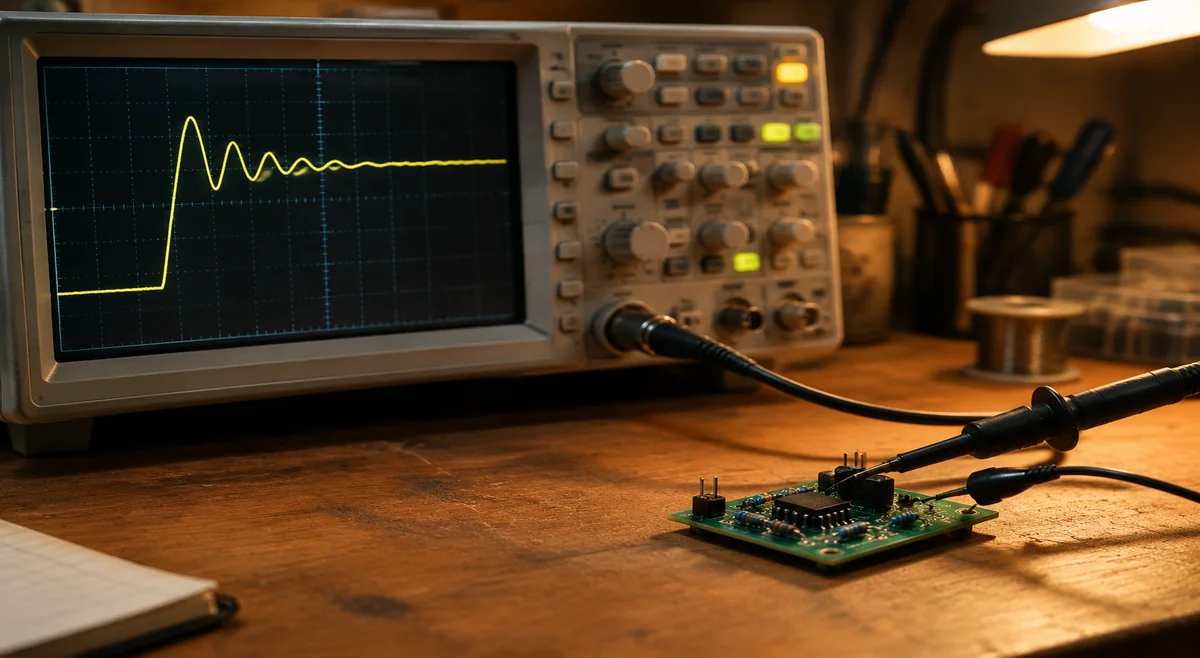
An op amp that oscillates is not a bad part — it is a part applied outside its stable region, and that is a selection failure, not a component failure. Capacitive loads are the classic trigger: driving a long cable, a MOSFET gate, or a large bypass capacitor directly can add enough phase shift to turn a quiet follower into an oscillator. Check whether the candidate is unity-gain stable; if it is only stable at higher gains, using it as a buffer demands an isolation resistor — or a different part. Watch the feedback network too: high-value resistors combined with input capacitance create a pole you never planned for. None of this appears in the headline specs, which is why stability belongs in the selection step rather than the debug step. If your load is capacitive or your gain is one, filter the shortlist for parts characterized for exactly that condition, per the datasheet rather than per habit. The oscillating follower often gets blamed on layout or decoupling for weeks before anyone checks whether the part is unity-gain stable. That check takes five minutes in the datasheet.
Selection snapshot: three real parts
Three classic dual op amps, three different answers. NE5532DR is the audio answer: low noise with the output drive to handle real loads — the right pick when the signal is audible and fidelity is the job. LM358DR is the single-supply workhorse: comfortable on one rail down to low voltages and economical — the right pick for general-purpose DC tasks such as sensor buffering and simple control loops, where ultimate precision is not required. TL082CMX/NOPB is the high-impedance answer: JFET inputs draw almost no bias current, ideal for photodiode or piezo front ends — but it is not rail-to-rail, so keep it on split supplies or a generous single rail and mind the input range. The decision rule never changes: name the signal, name the supply, and the table points at one row. Confirm the exact specs against the datasheet before committing.
- Audio or low-noise path → NE5532DR: choose for noise and load drive.
- General single-supply DC work → LM358DR: choose for rail flexibility and simplicity.
- High-impedance source on split supplies → TL082CMX/NOPB: choose for JFET inputs; mind the non-rail-to-rail input range.
Market availability and buying practice
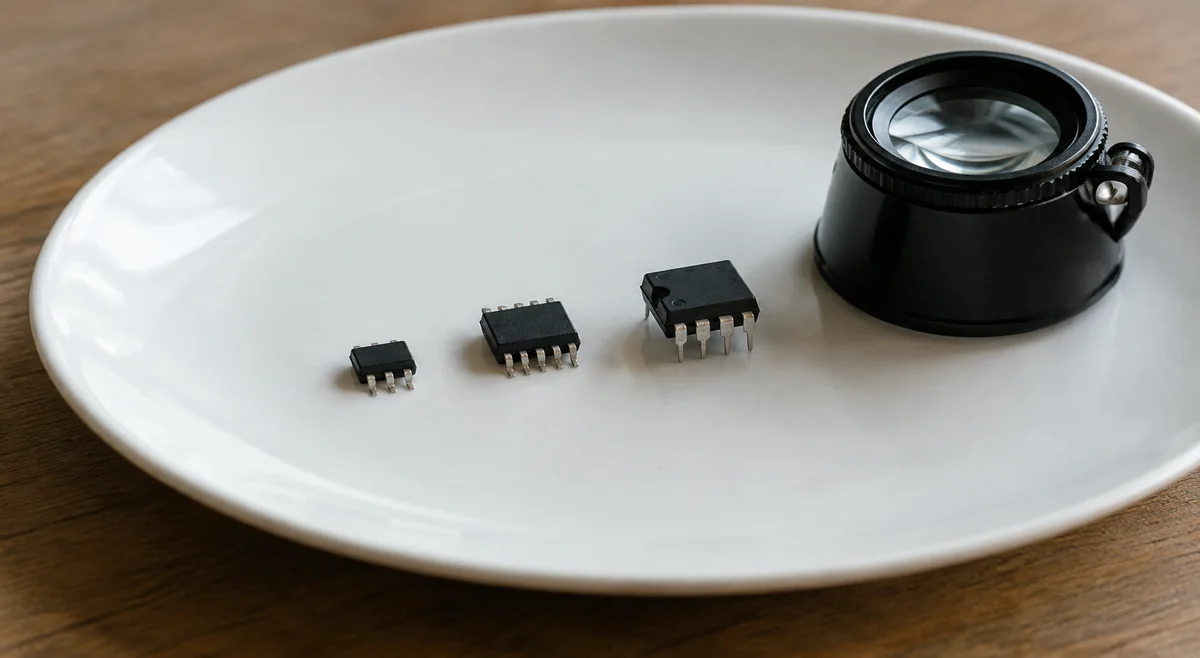
Classic dual op amps have long production histories across multiple vendors — check current listings on your usual marketplace rather than assuming any specific channel’s stock. That availability is an advantage and a trap: the same popularity means dense, lookalike suffixes. The channel count is part of the ordering code — single, dual, and quad versions are different devices, so the BOM must carry the exact code. NE5532DR and its single-channel sibling are not interchangeable, and neither are temperature or voltage variants hiding behind similar codes. Domestic alternatives are plentiful for these sockets, but offset and noise are exactly the parameters where substitutes diverge — verify each critical spec against the datasheet instead of assuming equivalence. A Douyin video by @Pudingge Explains Circuits (414 likes, observed 2026-09-30) makes the counterfeit point from the test bench: a fake amplifier chip caught by abnormal output levels — Fail! Bought a fake chip for a power amplifier: inverting input above non-inverting input, yet the output is high?. Treat a suspiciously cheap lot as guilty until the datasheet specs check out. For live availability, search the complete ordering code on the mall of your choice and read the current listings yourself; static prose cannot track a moving market, but the method stays valid. When the shortlist is set, put the full ordering codes on one RFQ with the noise, bandwidth and supply-range requirements stated for each line — that is how a comparison becomes a purchase.
Frequently asked questions
Quick answers to the questions buyers ask most about choosing op amps.
- Q: Which specification matters most? A: The one your signal demands — offset and drift for slow DC chains, noise density for audio, gain-bandwidth and slew rate for fast pulses. Name the signal first.
- Q: 'Single-supply' means rail-to-rail, right? A: No — it only means the part is characterized for single-rail operation. Rail-to-rail input and rail-to-rail output are separate claims; verify each one.
- Q: My voltage follower oscillates — is the part defective? A: Probably not. Capacitive loads, or using a decompensated part at unity gain, cause oscillation — that is a selection issue. Check stability for your gain and load.
- Q: Can I substitute another brand's 'equivalent' op amp? A: Verify offset and noise against the datasheet first — those are exactly the parameters where substitutes diverge.
Sources
Use the latest guidance for the exact part and manufacturer when deciding acceptance criteria.