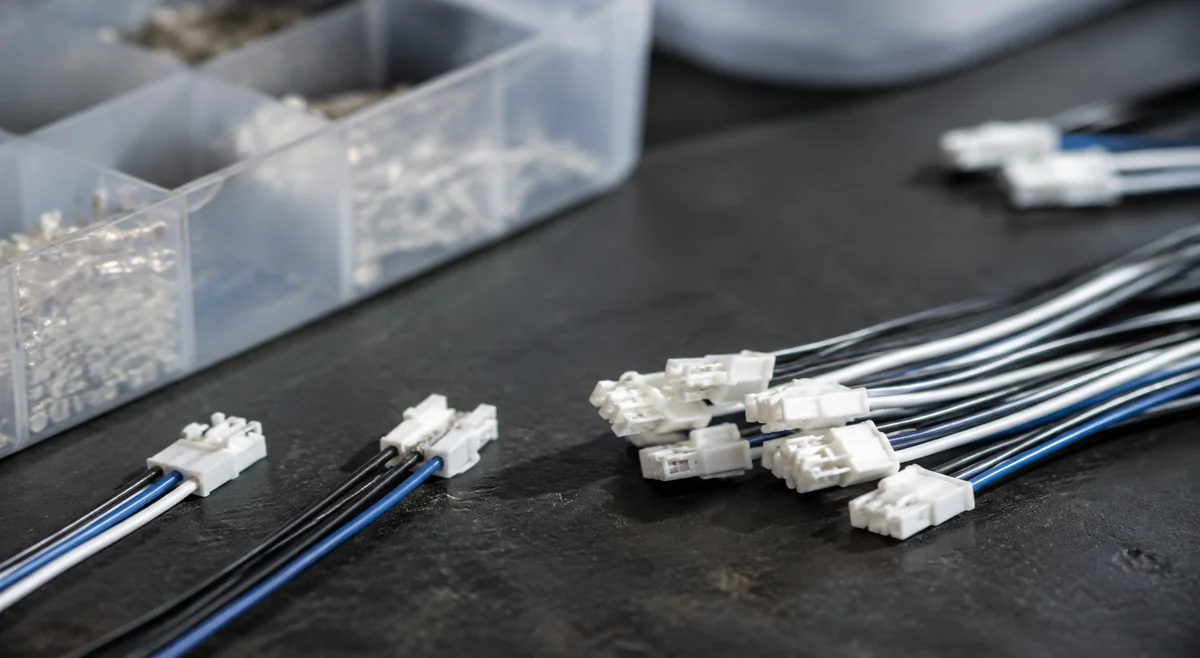
Start with pitch and load, not with habit
The naming is the first trap: XH, PH and SH are not interchangeable "JST connectors". They are different pitches — 2.5 mm, 2.0 mm and 1.0 mm — with different ceilings: XH is rated 3 A / 250 V, PH 2 A / 100 V and SH 1 A / 50 V, per JST's own series pages. Picking by whatever is already on the bench is how a board ends up with a 1 A connector carrying a motor lead. The decision runs on two axes. If the circuit needs more than 2 A or more than 100 V, PH is out and XH is the answer among the three; XH also accepts heavier wire (AWG #30 to #22 per the JST catalog) and is the easiest to hand-assemble. If board space is the binding constraint, PH buys density XH cannot — JST lists an 8 mm mounting height and 4.5 mm width for the top-entry version — at the cost of the lower 2 A / 100 V ceiling and thinner wire (AWG #32 to #24). If the job is a compact signal interconnect on an SMT-only flow, SH fits — but it is an SMT-mount series rated 1 A / 50 V, so it never substitutes for power. The second axis is mating and service. All three series use friction locks with top- and side-entry headers, so choose the entry direction against the enclosure and the service plan, not the catalog default. And measure before you assume: XH is 2.5 mm pitch, not 0.1 in (2.54 mm) — a near-miss pitch drifts pin alignment across a long row.
- Write the required current and voltage on the BOM line before the series name.
- XH for 3 A / 250 V and easy assembly; PH for dense boards at 2 A / 100 V; SH for compact SMT signal links at 1 A / 50 V.
- Confirm the header mounting (through-hole vs SMT) matches your assembly process — SH is SMT-mount.
- Never substitute by look: confirm the 2.5 / 2.0 / 1.0 mm pitch with calipers on the sample.
One connector is three orderable parts
A wire-to-board JST connection is a system of three pieces: the crimp housing (the XHP series for XH), the crimp contact (for example SXH-001T-P0.6), and the board-side header (for example B2B-XH-A(LF)(SN) or S5B-XH-A-1(LF)(SN)). The series name — XH — is the family; the part number names one piece of it. Ordering "XH" alone orders nothing. A common BOM error lists only the housing: the housings arrive, the boards get their headers, and the harness cannot be built because nobody ordered the contacts. The matching rule is simple and strict — the digit group in the code names the circuit count (2 in B2B-XH-A, 5 in S5B-XH-A-1), and housing, contacts and header must share it. A 2-circuit header will not mate a 5-circuit housing. The procurement move is to quote all three lines together and keep tooling in the picture: contacts are crimped with series-specific applicators that JST lists per contact in the catalog, so switching series mid-project also switches tooling. A frequent naming confusion to clear up early: XHP is the plug housing inside the XH family, not a separate series — "XH vs XHP" is a category error, not a selection decision.
- Always order the trio — housing + contact + mating header — with matching circuit counts.
- Read the digit group as the circuit count and match it across all three pieces.
- Treat the series name as a family, never as an orderable part number.
- Confirm crimp tooling for the contact before committing a series to a production run.
Crimp or IDC: decide by harness volume
JST publishes IDC-compatible mates for the same pitches: PH lists KR/KRD IDC mates, XH lists NR/NRD, and SH lists SR in the series remarks. Same connector family, different termination method — the decision is really about how the harness gets built, not about the connector's electrical rating. Crimp wins for prototypes, repairs and mixed wire gauges: any wire inside the series' specified range can be terminated, and the harness design can change without retooling the cable line. IDC wins for stable, high-volume harnesses: insulation-displacement termination is fast and consistent on a production line, which is exactly why JST keeps both variants alive for the same pitch. The catch buyers discover too late: IDC only works with the cable types the IDC connector is specified for. It is not a shortcut for arbitrary wire, and an IDC joint cannot be field-reworked the way a crimped contact can. Ordering IDC headers into a repair stock, where technicians expect to re-terminate by hand, is a classic mismatch. Put the termination method on the drawing so purchasing never substitutes one for the other.
- Prototype and service stock: crimp. Stable high-volume harness: IDC.
- PH pairs with KR/KRD, XH with NR/NRD, SH with SR — order the IDC variant only with its specified cable.
- IDC saves harness labor but removes field-rework flexibility.
- Write the termination method on the drawing and the RFQ line.
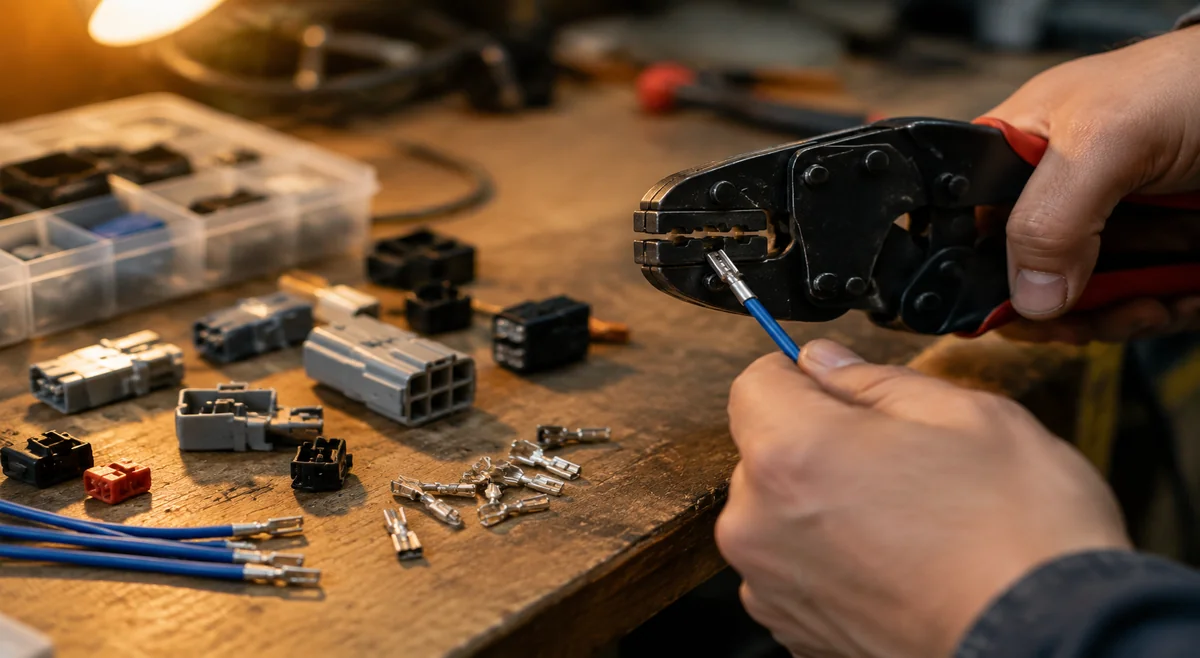
Read the suffixes before you quote
The suffix buyers trip over most is (LF)(SN): it marks the RoHS version. JST's own 2023 prefix/suffix notice states it was an orderable suffix and is no longer required. The practical consequence: B2B-XH-A quoted with or without (LF)(SN) is the same current product, not a different revision — do not reject a quote or a lot over its presence or absence. The same notice covers the bracketed prefixes that sometimes appear at the start of a code, such as (D), (W) or (G): they are JST's internal factory ship points and carry no functional meaning. They change where the reel shipped from, not what is on it. What does change the part is the rest of the code: the circuit-count digits, the mounting-variant letters and the series letters themselves. So the quoting rule is short — copy the complete code exactly, suffixes included, and confirm its identity against the JST catalog page rather than a marketplace listing title. When two suppliers quote "the same" connector at visibly different scope, the difference is almost always hiding in a dropped suffix or a shortened code.
- (LF)(SN) marks the RoHS version; JST says it is no longer required, so with or without it is the same part.
- Bracketed prefixes like (D) or (W) mark JST's ship point — no functional difference.
- Circuit count and mounting letters are the characters that actually change what ships.
- Quote the complete code every time; never shorten it to the series name.
Buy the exact code, not the series name
Series names are widely reused by third-party "compatible" makers, so a listing titled "JST XH" may not be JST at all. If genuine interchangeability matters for your product — lock feel, contact behavior over life, agency approvals — the mitigation is unglamorous: the exact manufacturer part number, ordered through an authorized channel, verified against the JST catalog. Take a 2-circuit header as an illustration: the same 2.5 mm XH family ships as a top-entry through-hole header and as an SMT header, so "XH 2-pin" on a quote does not name one part — the mounting style decides what actually arrives on the reel. Fully specified codes such as B2B-XH-A(LF)(SN) exist precisely to remove that ambiguity. Three checks close the loop before you approve a supplier: measure the pitch on a sample, since 2.5 / 2.0 / 1.0 mm differences are caliper-measurable; mate the housing to the header and feel the friction-lock engagement; and match the full code to the JST catalog entry. Keep the series straight in our JST connector lineup, and state the full code on every RFQ line — our guide on writing an RFQ that gets a useful answer shows how to make quotes come back comparable.
- Measure pitch on the sample; do not trust the listing title alone.
- Match the full ordering code to the JST catalog page, including mounting style.
- State top/side entry and through-hole/SMT on every RFQ line.
- Keep housing, contact and header on one purchase line group so nothing ships half-complete.
Frequently asked questions
The four questions buyers ask most once they move from the series name to real ordering codes.
- Q: Can I replace a PH connector with an XH one if PH is out of stock? A: No. The pitches differ (2.0 mm vs 2.5 mm), so footprints and mating housings do not interchange. Re-lay out the board for the new series instead of forcing a fit.
- Q: Is B2B-XH-A the same part as B2B-XH-A(LF)(SN)? A: Yes. (LF)(SN) marks the RoHS version, and JST's suffix notice says it is no longer required as an orderable suffix — treat them as the same current part.
- Q: What do I need besides the housing to build a working connection? A: The mating header for the board side and the correct crimp contacts (the SXH series for XH), all with the same circuit count as the housing.
- Q: Crimp or IDC for a production harness? A: JST's IDC mates — KR/KRD for PH, NR/NRD for XH, SR for SH — suit stable high-volume harnesses built with the specified cable. Crimp suits prototypes, repairs and mixed gauges, and it can be reworked in the field.
Sources
Use the latest guidance for the exact part and manufacturer when deciding acceptance criteria.