What was actually announced
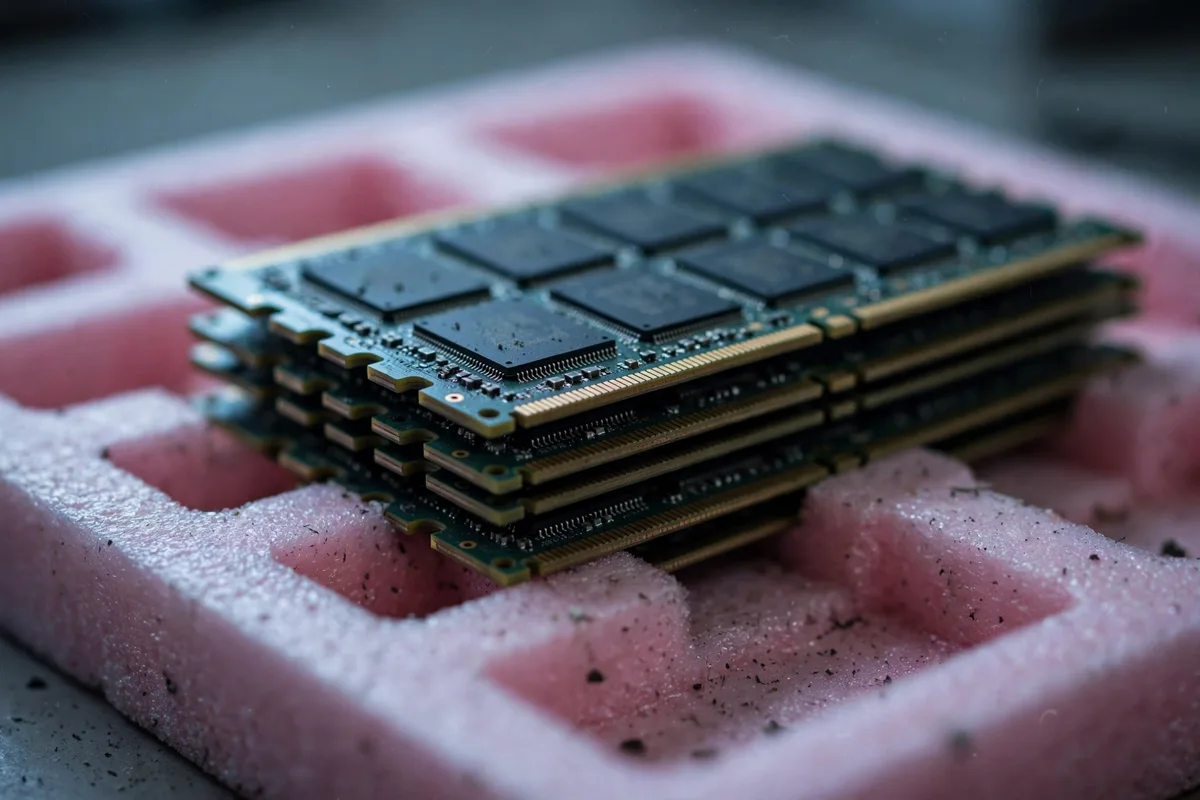
On September 30, Micron told investors that memory demand will exceed supply in 2027 and 2028 — tighter than 2026. Most buyers read that as DRAM and NAND are going to hurt. Fair enough. But if your BOM is mostly analog, power, and passives, the part of this story that matters to you is not the memory price. It is what a memory supercycle does to the fabs, the distributors, and the allocation queues behind your parts. This page is not a memory market report — we do not sell memory. It is a transmission map: how the supercycle reaches the rest of your BOM, and the procurement moves worth making before it does. The facts, all sourced and dated:
- Micron's earnings call (September 30, 2026): management said demand will outrun supply through 2027–2028, tighter than this year; the company has signed 26 long-term agreements worth $32 billion, some running through 2031 (Wall Street Journal, October 1, 2026; ChosunBiz, October 1, 2026).
- Price trajectory: TrendForce expects flash prices to reach roughly 4x their mid-2025 level by year-end, and server memory roughly 6x — forecasts, not spot quotes; treat them as direction, not as a number to put in a PO.
- Buyers are already locking in long: China Mobile's tender for 40 million memory chips (¥976 million), with supplier qualification running through the end of 2028, is the procurement-side version of Micron's LTAs — big buyers are buying certainty, not just chips (新浪财经, September 24, 2026).
- Consumer-market signal: DDR5 modules reportedly rose from around ¥500 to ¥3,500, and mobile memory prices were up about 80% quarter-on-quarter in Q2 (新浪, September 16, 2026).
The transmission chain — how this reaches your analog, power, and passives
Read together, the message is consistent: the tightness is structural, multi-year, and already changing how large buyers contract. Memory makers do not make your op-amps — so why should a DRAM shortage move your LDO lead time? Three links, each straightforward. First, advanced capacity soaks up everything around it. AI demand is pulling investment and equipment toward leading-edge nodes; mature-node capacity — the 40nm-and-above lines where much of the analog, power management, and discrete world lives — does not grow in that environment. At best it stays flat; some of it gets converted or deprioritized. When the industry's growth all points one way, the lines your parts are built on get less attention, not more. Second, allocation follows the money. In a supercycle, foundry and IDM capacity planners protect their highest-margin, highest-growth customers first. Memory and AI-adjacent products sit at the front of that queue; mature analog and power products, with thinner margins and steadier demand, historically sit further back — which is exactly where lead times stretch first when the queue gets long. Third, distributor behavior spills over. When buyers panic-stock one category, distributors' working capital, allocation effort, and warehouse priorities tilt toward it. Spot-market heat in memory does not stay in memory: the same brokers, the same freight lanes, and the same anxious buyers start behaving the same way about adjacent categories. You do not need memory on your BOM to feel the secondhand effects. None of this says your specific parts will go on allocation. It says the mechanism exists, it is mechanical rather than mysterious, and it is the same mechanism that has bitten mature-node buyers in every previous cycle. Watch the mechanism, not the headlines.
Four procurement moves to make now
This is the part most memory-supercycle coverage skips, because it is written for investors. You are a buyer — here is the practical version:
- Mirror the big buyers: contract certainty while your categories are still quiet. If you have stable, forecastable demand on analog or power parts, this is the window to negotiate longer-horizon agreements — not after your category becomes the headline.
- Qualify second sources before you need them. Second-source qualification is a when-calm activity: once allocation hits, every unqualified alternative is a redesign, a re-test cycle, or a broker premium.
- Pull your safety-stock window forward — selectively. Look at the mature-node parts on your BOM (older regulators, standard logic, commodity discretes) and ask whether your current buffer assumes a lead-time environment that may not exist in 2027. Adjust the buffer where the answer is no; leave the rest alone.
- Write RFQs that survive a rising market. State your volume, your delivery horizon, and whether you want pricing held, so every supplier quotes against identical assumptions. Our guide to writing a better RFQ covers the format that gets comparable answers.

What we're watching (and what would change this assessment)
Honesty first: this is a developing cycle, and the transmission described above is a mechanism to monitor, not a forecast with a date on it. Three signals would tell us the spillover is actually arriving: distributor lead-time trend reports starting to move on mature analog and power families — not memory, your categories; a new round of manufacturer price letters on analog and power parts citing capacity or cost (our shortage BOM playbook explains how to read those letters); and foundry utilization commentary shifting from AI nodes full to mature nodes tightening. We will update this page as those signals develop — check the dateModified stamp. If the cycle fizzles for non-memory categories, we will say so here rather than quietly leaving a scary headline up.
Frequently asked questions
Quick answers to the questions buyers ask most about the memory supercycle.
- Q: I do not buy memory at all. Why should I care? A: Because the supercycle is not really about memory — it is about where the industry's capacity, capital, and attention go for the next two to three years. Your analog, power, and passive parts are built on mature capacity that does not benefit from AI-driven investment. When the queue gets long, mature-node buyers feel it first.
- Q: When would this actually hit lead times for analog and power parts? A: No honest source puts a date on that, and neither do we. Memory tightness is confirmed for 2027–2028; spillover into adjacent categories lags the headline, it does not lead it. Use the lag as your preparation window.
- Q: Should I stock up now? A: Selectively, not broadly. What deserves attention is your safety stock on mature-node analog, power, and discrete parts where you are single-sourced or running lean buffers — review the buffer against a 2027 lead-time scenario and adjust where it breaks.
- Q: How do I write an RFQ that protects me in a rising market? A: State volume, delivery horizon, and price-hold expectations explicitly so every supplier quotes against identical assumptions — in a tight market the vague RFQs get answered last. See How to Write an RFQ That Gets You Comparable Quotes, and send the finished RFQ through our /rfq page.
Manufacturer references
Use the latest guidance for the exact part and manufacturer when deciding acceptance criteria.
- Wall Street Journal (2026-10-01) — Micron profit, revenue surge; demand to exceed supply through 2028; 26 long-term agreements worth $32B
- ChosunBiz (2026-10-01) — Micron signals prolonged memory shortage
- 新浪财经 (2026-09-24) — China Mobile ¥976M tender for 40M memory chips; supplier qualification through end of 2028